

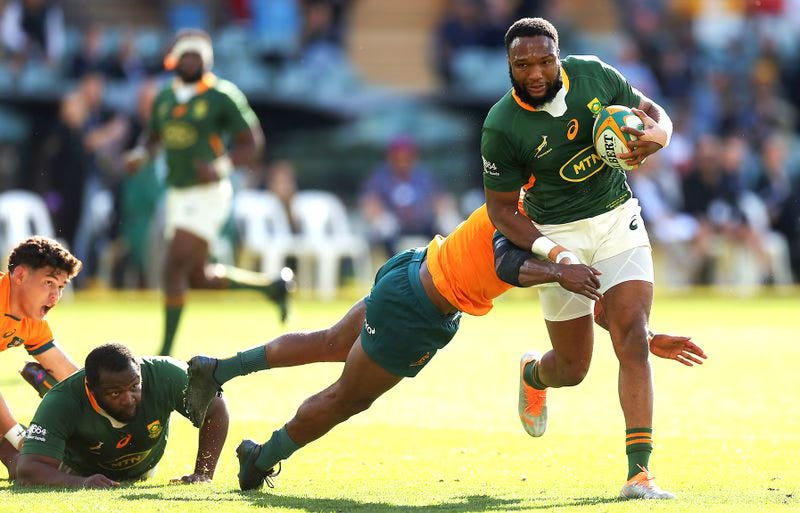
Several years ago, lovers and supporters of South African rugby were hotly debating what was affectionately called “The Quota System”. Shorthand for “add blacks to your team.”
Quota System: A policy that requires a minimum number of individuals from underrepresented groups to be included in a team, organisation, or institution in order to accelerate transformation and improve representation.
In rugby, and other sporting codes, it was put in place to promote racial diversification in rugby. Up until around 1995, rugby was, for the most part, considered an exclusively white sport. Specifically, it was mostly reserved for white Afrikaaners, and used as a tool for nation-building. Afrikaaner nation-building.
It is a discussion that has nowadays largely gone silent in the public arena. But there was a time, in the late 1990s and early 2000s, when it was all the rage. Depending on which side of the colour line you stood, you likely had a very strong opinion either for or against the system.
Many rugby players, like me, got caught in the crossfire of this debate.
You see, when I started playing at provincial level, quotas had just become a requirement: a minimum of three “players of colour” on the field at all times, and five in the squad. Throughout most of my school career (three years at A-team level and two at 1st team level), I was constantly the only “player of colour” in the team each year. At that time schools were exempt from complying with the quota system.
At U19 and U21 level, when I played in Pretoria for the Blue Bulls and the University of Pretoria, it was the first time I heard people refer to me as a “quota player”. It introduced a doubt in me about whether I deserved to be in the team or not. It also created an inter-team dynamic where there were the ins and the outs. Circles within circles.
Despite the fact that there were many good black players- there only ever three on the field, and five on the match-day squad. No more, no less.
It never sat well with me that there was this inherent question hanging over me, “Is he there on merit?” Whether in my own mind or in the minds of others.
In time, what I learnt from that experience is that the this pain of transforming in rugby was necessary. I just so happened to be amongst those who felt it acutely. To be clear, I am not saying that only “players of colour” felt the pain. I am sure that there were deserving white players who did not make a team because space had to be made for a “player of colour”.
I look up to the players who charted the way ahead of me. Players like Chester Williams and Breyton Paulse who were my inspiration and rugby heroes.
What they taught players like me was that every game was an opportunity to prove that you were there on merit. The issue was that not all players on the field had this added pressure.
Williams and Paulse did. The doubters, many of them, saw how they performed on the field. Some of them even came to love and admire those players. Despite the fact that they were different. Despite the fact that they were black.
The quota system was a necessary tool in the transformation of the sport. In transforming the Springboks.
Perfect? Definitely not.
But I am convinced that I would not have had the opportunity to wear a Natal Schools jersey or a Tuks jersey, or a Blue Bulls jersey, at that time, if there had not been a quota system.
Not necessarily because I was would not have good enough to be selected on merit, but because the system would have made it easy to overlook me. To leave me out.
Because I was the odd one out, it would have been simpler for coaches to default to maintaining the status quo.
A team that largely shares the same customs and norms is more predictable, consistent, and easier to manage.
There is no need to consider another language when communicating moves and information.
No need to consider different food requirements for pre-match meals.
No need to consider cultural realities, such as parents attending another funeral on a Saturday morning when it is game day. Lack of transport from far-away homes. Players at practice without any eating any food during the school day.
There is no need to explain or avoid “normal” banter and jokes that skirt close to racial stereotypes, or are blatant discrimination.
If there had been no quota system to force change, change was unlikely to have happened.
Of this, I am convinced. Because people are people- regardless of skin colour.
We tend to default to what we know, what is easy, and what is convenient and to what is comfortable. We avoid what is painful, or difficult, or controversial (like writing this article :-).
The coaches, scouts, selectors, managers, and administrators would simply not have considered otherwise. And why would they?
So when we look at the Springbok team today, and consider players like Kolbe, Am, Mapimpi, Kolisi, Nche, Fassi, Willemse, and Feinberg-Mngomezulu, there is no-one who serious questions whether they are quota players or not.
The debate is moot.
The question then is: would they be there if there had never been a quota system?
BBBEE is faulty. Absolutely, yes.
Is there another way? Probably yes.
Is there a better way? I have no idea.
None of us seem to know what it is yet.
What I know is that until the system has transformed to the point where skin colour plays little direct part in determining opportunities for success, it may be a necessary pain that we all must endure.
Until, and I hope soon, it becomes a moot point. A meaningless debate. Much like the quota system has become. Even thought the system is still alive. Because, I figure, we actually care more about winning championships than about transformation.
May that day come soon.
And may it come in my lifetime.
I would value your constructive inputs.
Ps.- I will ignore any comments about reverse discrimination/ racism and quotas in soccer.
Ps. 2- Springbok rugby is not still perfect. I am aware that issues remain.